I was swimming at UQ for a month or so before I noticed a pattern: Wednesdays were a lot tougher on me than Tuesdays. I quickly then figured out that the regular squad training sessions followed a week-long plan of sprints on Monday, technique focus on Tuesday, heart-rate set on Wednesday and aerobic set on Thursday (see here for a bit on different types of sets). That was my introduction to the idea of periodization: a one week repeating cycle hitting the major systems in turn.
Since then my training periodization has developed a lot more depth and the one week repeating cycle no longer suffices. Periodization is about creating a plan for the training season with variations of focus in training. Before discussing periodization it is useful to define a few of the key words.
Macrocycle: the longest type of cycle, for many swimmers the macrocycle is about a year, or encompassing the whole season (of whatever length that may be).
Mesocycle: the mid-length cycle, mesocycles are around four to eight weeks and are based around the idea that it takes about six weeks (give or take) to produce significant adaptations to a training regime.
Microcycle: the shortest cycle, microcycles are usually a week long. In my experience, the biggest reason for incorporating the idea of a microcycle is to ensure that swimmers have sufficient rest - by the time I get to Saturday morning training, for instance, I am giving the last of what is in my training-tank for the week, so I really need the weekend rest to recover for the next week of training starting Monday morning.
All coaches use some kind of periodization unless the training sessions are literally random. Even the simple week progression I started with at UQ's adult squad sessions were a (basic) form of periodization. But periodization has benefits far beyond making it easier for the coach to pick what kind of set the swimmers will endure! As I see it, there are two main features of periodization:
1. Training is about overloading a system so that it adapts for the better, and a single training session cannot achieve this. So a benefit of periodization is to decide that the first mesocycle of the season can be dedicated to, for instance, endurance work. This provides enough of a stimulus for the swimmer to positively adapt and improve.
2. Periodization allows the coach to plan when the swimmers will be at their peak. Often there will be some kind of end-of-season meet where the swimmer will want to achieve their maximal performance, and intelligent planning allows the training schedule to produce a well-timed peak.
Having noted the importance of good periodization, what is a coach to do? A plethora of periodization plans exist, but they tend to fall into one of two camps:
- Linear: This is your most intuitive kind of periodization plan, where you take each mesocycle and dedicate it to a particular system. A coach might start with a mesocycle dedicated to endurance, then another to V02 max training, then heart-rate, then speed work and finish off with a week long taper before peaking at the end of the season. The major benefit to linear periodization is that it incorporates an ideal length of overload and allows the swimmer to peak at the right time of the season. This comes with drawbacks, however: the idea behind linear periodization is to peak at the end, so in-season racing is going to be decidedly subpar. Additionally, there is the possibility of atrophy of systems as time progresses and it has been ever-longer since that system was worked - in the example, endurance might be flailing by the time speed work is begun. Finally, what if injury or personal circumstance leads to missing a few weeks of practice? Suddenly an athlete may have missed training an entire system crucial to their race performance.
In an attempt to mitigate these factors, the other camp suggests:
- Non-linear: Instead of linearly progressing through the systems, the non-linear plan says to focus on multiple at a time, whilst still varying over the course of the season. Sometimes referred to as an undulating periodization, this type of plan rotates through more frequently over the course of a season, and so allows for multiple peaks (whilst some kind of maximal peak can still be achieved by taper at the end of the season). It also allows for more flexibility when swimmers miss blocks of training. It seems, however, to have mitigated one of the major benefits of the linear plan: there may not be enough training stimulus for highly trained athletes to improve. Furthermore, some types of systems' training are hard (if at all possible) to combine: sprint sets and endurance/aerobic sets are fundamentally different, so producing training adaptations in both seems difficult.
------------------------------
Added to these considerations, the coach needs to address the particular needs of the individual swimmer. I, for instance, would probably benefit from an increased focus on endurance work. This would allow me to have a greater capacity for training, so provide a platform for training the other systems. I furthermore breakdown in breaststroke over too long a distance, so it would give me the ability to push through fatigue with proper form (particularly turns).
Outside the pool, there is also much to be said for the periodization of dryland activities. That in itself is a universe of controversy - some coaches even reject the need for dryland!
Showing posts with label training. Show all posts
Showing posts with label training. Show all posts
Friday, 18 December 2015

Friday, 4 December 2015
The Types of Sets in Swimming
Training at an elite level, or to achieve an elite level, is not easy. It is incredibly taxing physically, mentally and socially. In terms of time, swimming training is particularly intensive - for me, it involves two swimming sessions a day from Monday-Friday, around half an hour of dryland (every form of exercise not done in the pool is referred to as "dryland") each of those days before the evening training session, plus an hour in the gym working on strength on Tuesdays and Thursdays. Then on the weekend, there's a slightly longer morning training on Saturday, half an hour of core-specific work right afterwards then and I'm done for the day. On Sunday, I go to another couple of dryland sessions, one focusing on mobility and flexibility in the morning, the other a faster-paced strength session in the afternoon.
So even if you include the daily half-hour dryland into the evening session, that's sixteen distinct training sessions a week. Which is a lot. But swimming training is not just about hard work; it's also about smart work. I do not think coaches are given enough credit for the time and expertise that goes into structuring and implementing a training program: in the past, when the science was ambiguous, coaches trained their athletes in the dark - quite the challenge - and now there is so much science that a great coach is a very intelligent person having invested enormous time resources resulting in significant expertise in all sorts of sports science ranging from bio-mechanics to psychology.
Not being such an intelligent coach (or a coach at all, for that matter), I cannot claim to know that much about the complicated thought-process that for some coaches has become second-nature in creating a training schedule. There's an aerobic season and a speed season - but you're always training aerobically and speed within both seasons. There's the complicated taper time. There's all sorts of types of training and with each, a range of opinion among the swimming community as to what works best - is USRPT really all that it's cracked up to be? Should garbage yardage be the backbone of a swimming regime? How much time should be spent on dryland? I might have opinions but I do not have answers.
I want to start a series of posts explaining the logic behind the training program that my coach(s) implement with me. To start off with, it's important to understand the kind of sets that make up training in the pool. In the pool, I would say there are really four distinct categories of set and a fifth miscellaneous set which combines elements from the others. These are:
- Drill sets: Here I work on the technical aspects of the stroke and of the race, focusing on making sure the technique is conducive to the fastest times by reducing drag, ensuring that the stroke is effective, and so on. Whilst usually less physically demanding, they are important to set the stage for optimal swimming. Water is an unforgiving medium with much more drag than air to slow me down, and an intense training schedule means poor form repeated over hundreds of kilometers is bound to result in injury. So perfecting technique is crucial to swimming.
- Aerobic sets: These are longer sets where, as I understand it, the aim is to be at 70-80% of my maximum heart rate and keep it there for a prolonged period of time. This improves both my aerobic and cardiovascular capacity, or in other words, improves my lungs and my heart. Even though I am a breaststroke specialist, I do not have special organs for breaststroke as opposed to every other stroke, so I will almost always do aerobic sets with freestyle. This allows me to rest the breaststroke specific muscles, develop a more rounded body, and still train my ability to use oxygen and my heart effectively. But for the heart there is also...
- Heart rate sets: These are some of the toughest sets, in my opinion, as they are mid-to-high intensity in terms of speed with minimal rest in between. Heart rate sets are about getting the heart rate up and keeping it there, so as to maximise the ability of the heart to work effectively under physical duress. They may not be as long as aerobic sets, but they are significantly faster.
- Sprint sets: My personal favourites, sprint sets are about going fast for a short amount of time and distance. Part of the reason I like sprint sets so much is that I can vary elements of my race and get instant feedback on how it impacts my performance - as the coach says, the clock is your best friend, who is always there and never lies to you. More than just testing fields for subtle technique changes, sprint sets are about putting together the rest of the training to make sure that it all comes together in an effective and fast end-product. Drill sets may be important, but two-kicks-one-pull breaststroke will never be an Olympic event!
- Combinations: Whilst I think the above four categories cover the main types of sets, it is important to understand that they can be combined. Heart rate sets, for instance, can be made longer (more like an aerobic set) or shorter (more like sprints). Sprint sets need not be full-stroke, they could be sprint kick sets, for instance - and kicking is basically a drill. Similarly there could be aerobic drill sets.
A typical session in the pool will, for me, usually involve some sort of drill set and usually one other element from these categories (sometimes two). How do you arrange the focus of a training session over the course of a season and its off-season? That's another question.
So even if you include the daily half-hour dryland into the evening session, that's sixteen distinct training sessions a week. Which is a lot. But swimming training is not just about hard work; it's also about smart work. I do not think coaches are given enough credit for the time and expertise that goes into structuring and implementing a training program: in the past, when the science was ambiguous, coaches trained their athletes in the dark - quite the challenge - and now there is so much science that a great coach is a very intelligent person having invested enormous time resources resulting in significant expertise in all sorts of sports science ranging from bio-mechanics to psychology.
 |
| Swimming sets are probably a little less complicated than metaphysics. |
I want to start a series of posts explaining the logic behind the training program that my coach(s) implement with me. To start off with, it's important to understand the kind of sets that make up training in the pool. In the pool, I would say there are really four distinct categories of set and a fifth miscellaneous set which combines elements from the others. These are:
- Drill sets: Here I work on the technical aspects of the stroke and of the race, focusing on making sure the technique is conducive to the fastest times by reducing drag, ensuring that the stroke is effective, and so on. Whilst usually less physically demanding, they are important to set the stage for optimal swimming. Water is an unforgiving medium with much more drag than air to slow me down, and an intense training schedule means poor form repeated over hundreds of kilometers is bound to result in injury. So perfecting technique is crucial to swimming.
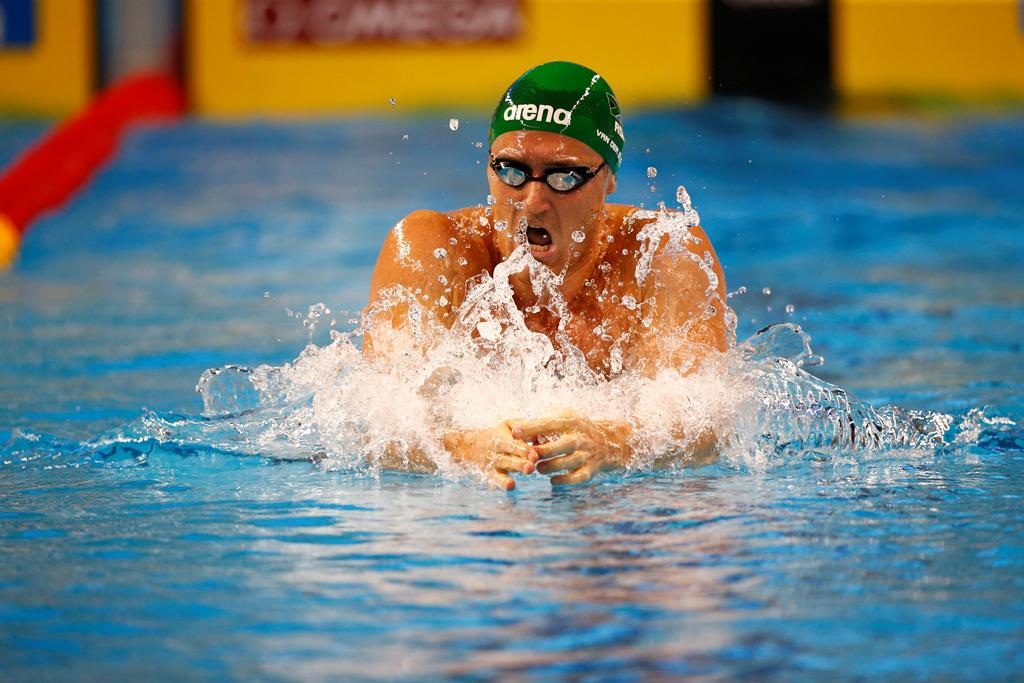 |
| Perfecting the breathing yawn face is a lifelong process. Alas, no medals are given for how bored snapshots of swimmers' faces look. (Photo: Swimming World) |
- Heart rate sets: These are some of the toughest sets, in my opinion, as they are mid-to-high intensity in terms of speed with minimal rest in between. Heart rate sets are about getting the heart rate up and keeping it there, so as to maximise the ability of the heart to work effectively under physical duress. They may not be as long as aerobic sets, but they are significantly faster.
- Sprint sets: My personal favourites, sprint sets are about going fast for a short amount of time and distance. Part of the reason I like sprint sets so much is that I can vary elements of my race and get instant feedback on how it impacts my performance - as the coach says, the clock is your best friend, who is always there and never lies to you. More than just testing fields for subtle technique changes, sprint sets are about putting together the rest of the training to make sure that it all comes together in an effective and fast end-product. Drill sets may be important, but two-kicks-one-pull breaststroke will never be an Olympic event!
- Combinations: Whilst I think the above four categories cover the main types of sets, it is important to understand that they can be combined. Heart rate sets, for instance, can be made longer (more like an aerobic set) or shorter (more like sprints). Sprint sets need not be full-stroke, they could be sprint kick sets, for instance - and kicking is basically a drill. Similarly there could be aerobic drill sets.
A typical session in the pool will, for me, usually involve some sort of drill set and usually one other element from these categories (sometimes two). How do you arrange the focus of a training session over the course of a season and its off-season? That's another question.
Subscribe to:
Posts (Atom)