At bottom, all success is failure. In sports, even a world-record breaking, gold medal winning performance against a stacked field is a failure to go faster still. In business, the most innovative and successful product could have been even more so. In life, you could always have done better. If this were not true, no progress would ever occur anymore: if nobody could go faster than Usain Bolt in a 100m sprint, nobody would bother trying.
That sounds pretty bleak. But if you have been on the road for a while, perhaps you realise something: almost every important success came with a bunch of times of falling short of that win. So if we are honest with ourselves, the path to success is pretty bleak anyway.
Often it is hard to quantify how well or badly we do, but one benefit of swimming is how reliably merciless the clock is in doing it for me. After touching the wall at the end of the race I can always look up to see what time I did. At the end of the day the difference between a successful swim and an unsuccessful is entirely in my head: did I achieve what I wanted, the bar I set for myself? If not, it was a failure. Even a personal best could be a failure if it was not as good as I wanted.
But a personal best, even if it is below what I wanted, is still better than last time. I failed a little less. Let me put it in a slightly geeky way: nothing in the universe can travel faster than the speed of light (in a vacuum). Therefore, the best upper limit for how fast someone can swim the 100m breaststroke is that nobody will ever exceed the speed of light (which means a time of about 333 nanoseconds, which is way below the 0.01 second accuracy of swimming clocks). So in a sense, anything more than that fastest time possible is a failure.
Not getting to the speed of light in breaststroke is probably something you can be forgiven for, but such an insane "goal" highlights the point: standards are artificial. Real success is falling short a little less than before.
Showing posts with label swimming. Show all posts
Showing posts with label swimming. Show all posts
Wednesday, 10 February 2016

Friday, 18 December 2015
Periodization in Swimming
I was swimming at UQ for a month or so before I noticed a pattern: Wednesdays were a lot tougher on me than Tuesdays. I quickly then figured out that the regular squad training sessions followed a week-long plan of sprints on Monday, technique focus on Tuesday, heart-rate set on Wednesday and aerobic set on Thursday (see here for a bit on different types of sets). That was my introduction to the idea of periodization: a one week repeating cycle hitting the major systems in turn.
Since then my training periodization has developed a lot more depth and the one week repeating cycle no longer suffices. Periodization is about creating a plan for the training season with variations of focus in training. Before discussing periodization it is useful to define a few of the key words.
Macrocycle: the longest type of cycle, for many swimmers the macrocycle is about a year, or encompassing the whole season (of whatever length that may be).
Mesocycle: the mid-length cycle, mesocycles are around four to eight weeks and are based around the idea that it takes about six weeks (give or take) to produce significant adaptations to a training regime.
Microcycle: the shortest cycle, microcycles are usually a week long. In my experience, the biggest reason for incorporating the idea of a microcycle is to ensure that swimmers have sufficient rest - by the time I get to Saturday morning training, for instance, I am giving the last of what is in my training-tank for the week, so I really need the weekend rest to recover for the next week of training starting Monday morning.
All coaches use some kind of periodization unless the training sessions are literally random. Even the simple week progression I started with at UQ's adult squad sessions were a (basic) form of periodization. But periodization has benefits far beyond making it easier for the coach to pick what kind of set the swimmers will endure! As I see it, there are two main features of periodization:
1. Training is about overloading a system so that it adapts for the better, and a single training session cannot achieve this. So a benefit of periodization is to decide that the first mesocycle of the season can be dedicated to, for instance, endurance work. This provides enough of a stimulus for the swimmer to positively adapt and improve.
2. Periodization allows the coach to plan when the swimmers will be at their peak. Often there will be some kind of end-of-season meet where the swimmer will want to achieve their maximal performance, and intelligent planning allows the training schedule to produce a well-timed peak.
Having noted the importance of good periodization, what is a coach to do? A plethora of periodization plans exist, but they tend to fall into one of two camps:
- Linear: This is your most intuitive kind of periodization plan, where you take each mesocycle and dedicate it to a particular system. A coach might start with a mesocycle dedicated to endurance, then another to V02 max training, then heart-rate, then speed work and finish off with a week long taper before peaking at the end of the season. The major benefit to linear periodization is that it incorporates an ideal length of overload and allows the swimmer to peak at the right time of the season. This comes with drawbacks, however: the idea behind linear periodization is to peak at the end, so in-season racing is going to be decidedly subpar. Additionally, there is the possibility of atrophy of systems as time progresses and it has been ever-longer since that system was worked - in the example, endurance might be flailing by the time speed work is begun. Finally, what if injury or personal circumstance leads to missing a few weeks of practice? Suddenly an athlete may have missed training an entire system crucial to their race performance.
In an attempt to mitigate these factors, the other camp suggests:
- Non-linear: Instead of linearly progressing through the systems, the non-linear plan says to focus on multiple at a time, whilst still varying over the course of the season. Sometimes referred to as an undulating periodization, this type of plan rotates through more frequently over the course of a season, and so allows for multiple peaks (whilst some kind of maximal peak can still be achieved by taper at the end of the season). It also allows for more flexibility when swimmers miss blocks of training. It seems, however, to have mitigated one of the major benefits of the linear plan: there may not be enough training stimulus for highly trained athletes to improve. Furthermore, some types of systems' training are hard (if at all possible) to combine: sprint sets and endurance/aerobic sets are fundamentally different, so producing training adaptations in both seems difficult.
------------------------------
Added to these considerations, the coach needs to address the particular needs of the individual swimmer. I, for instance, would probably benefit from an increased focus on endurance work. This would allow me to have a greater capacity for training, so provide a platform for training the other systems. I furthermore breakdown in breaststroke over too long a distance, so it would give me the ability to push through fatigue with proper form (particularly turns).
Outside the pool, there is also much to be said for the periodization of dryland activities. That in itself is a universe of controversy - some coaches even reject the need for dryland!
Since then my training periodization has developed a lot more depth and the one week repeating cycle no longer suffices. Periodization is about creating a plan for the training season with variations of focus in training. Before discussing periodization it is useful to define a few of the key words.
Macrocycle: the longest type of cycle, for many swimmers the macrocycle is about a year, or encompassing the whole season (of whatever length that may be).
Mesocycle: the mid-length cycle, mesocycles are around four to eight weeks and are based around the idea that it takes about six weeks (give or take) to produce significant adaptations to a training regime.
Microcycle: the shortest cycle, microcycles are usually a week long. In my experience, the biggest reason for incorporating the idea of a microcycle is to ensure that swimmers have sufficient rest - by the time I get to Saturday morning training, for instance, I am giving the last of what is in my training-tank for the week, so I really need the weekend rest to recover for the next week of training starting Monday morning.
All coaches use some kind of periodization unless the training sessions are literally random. Even the simple week progression I started with at UQ's adult squad sessions were a (basic) form of periodization. But periodization has benefits far beyond making it easier for the coach to pick what kind of set the swimmers will endure! As I see it, there are two main features of periodization:
1. Training is about overloading a system so that it adapts for the better, and a single training session cannot achieve this. So a benefit of periodization is to decide that the first mesocycle of the season can be dedicated to, for instance, endurance work. This provides enough of a stimulus for the swimmer to positively adapt and improve.
2. Periodization allows the coach to plan when the swimmers will be at their peak. Often there will be some kind of end-of-season meet where the swimmer will want to achieve their maximal performance, and intelligent planning allows the training schedule to produce a well-timed peak.
Having noted the importance of good periodization, what is a coach to do? A plethora of periodization plans exist, but they tend to fall into one of two camps:
- Linear: This is your most intuitive kind of periodization plan, where you take each mesocycle and dedicate it to a particular system. A coach might start with a mesocycle dedicated to endurance, then another to V02 max training, then heart-rate, then speed work and finish off with a week long taper before peaking at the end of the season. The major benefit to linear periodization is that it incorporates an ideal length of overload and allows the swimmer to peak at the right time of the season. This comes with drawbacks, however: the idea behind linear periodization is to peak at the end, so in-season racing is going to be decidedly subpar. Additionally, there is the possibility of atrophy of systems as time progresses and it has been ever-longer since that system was worked - in the example, endurance might be flailing by the time speed work is begun. Finally, what if injury or personal circumstance leads to missing a few weeks of practice? Suddenly an athlete may have missed training an entire system crucial to their race performance.
In an attempt to mitigate these factors, the other camp suggests:
- Non-linear: Instead of linearly progressing through the systems, the non-linear plan says to focus on multiple at a time, whilst still varying over the course of the season. Sometimes referred to as an undulating periodization, this type of plan rotates through more frequently over the course of a season, and so allows for multiple peaks (whilst some kind of maximal peak can still be achieved by taper at the end of the season). It also allows for more flexibility when swimmers miss blocks of training. It seems, however, to have mitigated one of the major benefits of the linear plan: there may not be enough training stimulus for highly trained athletes to improve. Furthermore, some types of systems' training are hard (if at all possible) to combine: sprint sets and endurance/aerobic sets are fundamentally different, so producing training adaptations in both seems difficult.
------------------------------
Added to these considerations, the coach needs to address the particular needs of the individual swimmer. I, for instance, would probably benefit from an increased focus on endurance work. This would allow me to have a greater capacity for training, so provide a platform for training the other systems. I furthermore breakdown in breaststroke over too long a distance, so it would give me the ability to push through fatigue with proper form (particularly turns).
Outside the pool, there is also much to be said for the periodization of dryland activities. That in itself is a universe of controversy - some coaches even reject the need for dryland!
Friday, 4 December 2015
The Types of Sets in Swimming
Training at an elite level, or to achieve an elite level, is not easy. It is incredibly taxing physically, mentally and socially. In terms of time, swimming training is particularly intensive - for me, it involves two swimming sessions a day from Monday-Friday, around half an hour of dryland (every form of exercise not done in the pool is referred to as "dryland") each of those days before the evening training session, plus an hour in the gym working on strength on Tuesdays and Thursdays. Then on the weekend, there's a slightly longer morning training on Saturday, half an hour of core-specific work right afterwards then and I'm done for the day. On Sunday, I go to another couple of dryland sessions, one focusing on mobility and flexibility in the morning, the other a faster-paced strength session in the afternoon.
So even if you include the daily half-hour dryland into the evening session, that's sixteen distinct training sessions a week. Which is a lot. But swimming training is not just about hard work; it's also about smart work. I do not think coaches are given enough credit for the time and expertise that goes into structuring and implementing a training program: in the past, when the science was ambiguous, coaches trained their athletes in the dark - quite the challenge - and now there is so much science that a great coach is a very intelligent person having invested enormous time resources resulting in significant expertise in all sorts of sports science ranging from bio-mechanics to psychology.
Not being such an intelligent coach (or a coach at all, for that matter), I cannot claim to know that much about the complicated thought-process that for some coaches has become second-nature in creating a training schedule. There's an aerobic season and a speed season - but you're always training aerobically and speed within both seasons. There's the complicated taper time. There's all sorts of types of training and with each, a range of opinion among the swimming community as to what works best - is USRPT really all that it's cracked up to be? Should garbage yardage be the backbone of a swimming regime? How much time should be spent on dryland? I might have opinions but I do not have answers.
I want to start a series of posts explaining the logic behind the training program that my coach(s) implement with me. To start off with, it's important to understand the kind of sets that make up training in the pool. In the pool, I would say there are really four distinct categories of set and a fifth miscellaneous set which combines elements from the others. These are:
- Drill sets: Here I work on the technical aspects of the stroke and of the race, focusing on making sure the technique is conducive to the fastest times by reducing drag, ensuring that the stroke is effective, and so on. Whilst usually less physically demanding, they are important to set the stage for optimal swimming. Water is an unforgiving medium with much more drag than air to slow me down, and an intense training schedule means poor form repeated over hundreds of kilometers is bound to result in injury. So perfecting technique is crucial to swimming.
- Aerobic sets: These are longer sets where, as I understand it, the aim is to be at 70-80% of my maximum heart rate and keep it there for a prolonged period of time. This improves both my aerobic and cardiovascular capacity, or in other words, improves my lungs and my heart. Even though I am a breaststroke specialist, I do not have special organs for breaststroke as opposed to every other stroke, so I will almost always do aerobic sets with freestyle. This allows me to rest the breaststroke specific muscles, develop a more rounded body, and still train my ability to use oxygen and my heart effectively. But for the heart there is also...
- Heart rate sets: These are some of the toughest sets, in my opinion, as they are mid-to-high intensity in terms of speed with minimal rest in between. Heart rate sets are about getting the heart rate up and keeping it there, so as to maximise the ability of the heart to work effectively under physical duress. They may not be as long as aerobic sets, but they are significantly faster.
- Sprint sets: My personal favourites, sprint sets are about going fast for a short amount of time and distance. Part of the reason I like sprint sets so much is that I can vary elements of my race and get instant feedback on how it impacts my performance - as the coach says, the clock is your best friend, who is always there and never lies to you. More than just testing fields for subtle technique changes, sprint sets are about putting together the rest of the training to make sure that it all comes together in an effective and fast end-product. Drill sets may be important, but two-kicks-one-pull breaststroke will never be an Olympic event!
- Combinations: Whilst I think the above four categories cover the main types of sets, it is important to understand that they can be combined. Heart rate sets, for instance, can be made longer (more like an aerobic set) or shorter (more like sprints). Sprint sets need not be full-stroke, they could be sprint kick sets, for instance - and kicking is basically a drill. Similarly there could be aerobic drill sets.
A typical session in the pool will, for me, usually involve some sort of drill set and usually one other element from these categories (sometimes two). How do you arrange the focus of a training session over the course of a season and its off-season? That's another question.
So even if you include the daily half-hour dryland into the evening session, that's sixteen distinct training sessions a week. Which is a lot. But swimming training is not just about hard work; it's also about smart work. I do not think coaches are given enough credit for the time and expertise that goes into structuring and implementing a training program: in the past, when the science was ambiguous, coaches trained their athletes in the dark - quite the challenge - and now there is so much science that a great coach is a very intelligent person having invested enormous time resources resulting in significant expertise in all sorts of sports science ranging from bio-mechanics to psychology.
 |
| Swimming sets are probably a little less complicated than metaphysics. |
I want to start a series of posts explaining the logic behind the training program that my coach(s) implement with me. To start off with, it's important to understand the kind of sets that make up training in the pool. In the pool, I would say there are really four distinct categories of set and a fifth miscellaneous set which combines elements from the others. These are:
- Drill sets: Here I work on the technical aspects of the stroke and of the race, focusing on making sure the technique is conducive to the fastest times by reducing drag, ensuring that the stroke is effective, and so on. Whilst usually less physically demanding, they are important to set the stage for optimal swimming. Water is an unforgiving medium with much more drag than air to slow me down, and an intense training schedule means poor form repeated over hundreds of kilometers is bound to result in injury. So perfecting technique is crucial to swimming.
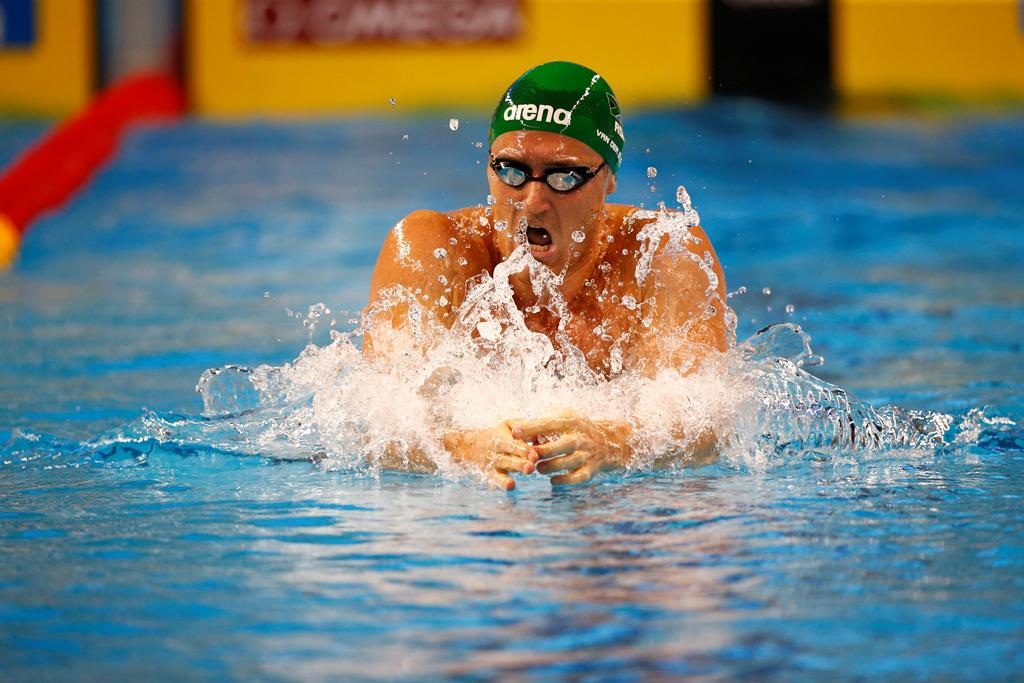 |
| Perfecting the breathing yawn face is a lifelong process. Alas, no medals are given for how bored snapshots of swimmers' faces look. (Photo: Swimming World) |
- Heart rate sets: These are some of the toughest sets, in my opinion, as they are mid-to-high intensity in terms of speed with minimal rest in between. Heart rate sets are about getting the heart rate up and keeping it there, so as to maximise the ability of the heart to work effectively under physical duress. They may not be as long as aerobic sets, but they are significantly faster.
- Sprint sets: My personal favourites, sprint sets are about going fast for a short amount of time and distance. Part of the reason I like sprint sets so much is that I can vary elements of my race and get instant feedback on how it impacts my performance - as the coach says, the clock is your best friend, who is always there and never lies to you. More than just testing fields for subtle technique changes, sprint sets are about putting together the rest of the training to make sure that it all comes together in an effective and fast end-product. Drill sets may be important, but two-kicks-one-pull breaststroke will never be an Olympic event!
- Combinations: Whilst I think the above four categories cover the main types of sets, it is important to understand that they can be combined. Heart rate sets, for instance, can be made longer (more like an aerobic set) or shorter (more like sprints). Sprint sets need not be full-stroke, they could be sprint kick sets, for instance - and kicking is basically a drill. Similarly there could be aerobic drill sets.
A typical session in the pool will, for me, usually involve some sort of drill set and usually one other element from these categories (sometimes two). How do you arrange the focus of a training session over the course of a season and its off-season? That's another question.
Monday, 30 November 2015
Hundreths and Thousanths
It is undeniably true that as a swimmer, Michael Phelps is the greatest Olympian of all time. His swimming record is unparalleled to such an extent that it makes winning a gold medal at the Olympics into a feat worthy of a polite nod of congratulations in comparison. History may give rise to someone that rivals the dominance of Phelps in 2008's Beijing, but for the moment his record stands tall and seemingly insurmountable. What history will no doubt forget more easily is how close Phelps came to coming second with his seventh gold medal. The finish was so close between Phelps and the Serbian Milorad Cavic that the Serbian team filed a protest which FINA dismissed after a review of the finish. By the smallest possible margin in swimming, 0.01 seconds, Phelps won.
That same review showed why Cavic lost to Phelps and eventually granted him the wreath of fame with eight gold medals: Cavic broke his streamline for the finish to look up. Had his head remained down until he reached the wall, he would have out-touched Phelps and denied him his honour - something he hoped would happen, saying it would be better for the sport if he did not make it to eight medals.
Cavic could have made that hundredth of a second. Swimming is full of those seemingly infinitesimal fractions of time; the possibilities to gain them hover endlessly from the moment the starting beep goes to the touching of the wall, in every stroke, breath, kick and turn. The margin for error in swimming is relentlessly small, as Cavic learnt: having his head up for just one stroke was the difference between gold and silver. If his coach had drilled into him for two minutes a day the importance of that streamline in the finish, perhaps he would have made it.
Those fractions of a second are everywhere. They are not only the difference in incredibly tight races like Olympic finals, they determine every race, because those hundredths add up. Bad reaction time? There goes 0.1 of a second. Start kicking underwater off of the start too early or too late? 0.2 of a second, maybe. Never trained a proper high elbow catch? 0.1 per stroke, possibly. Forgot to develop strong hypoxic skills? Your turn lost you half a second because you could not keep up the underwater phase. Legs fatigue in the first fifty? Your splits just lost a few seconds.
Enough training and those issues can be ironed out. The problem arises when we expect to be dropping seconds off our PBs every time we jump into the pool or walk into the gym. If every time we jump out of the pool we expect to be instantly gratified with our results, disillusion will quickly become our constant companion, so much so that despair and quitting will eventually become inevitable.
Every set in the pool or in dryland is about improving a thousandth of a second, or a tenth of a thousandth. These amounts go unnoticed by the clock (which measures to the hundredth) and yet we jump in knowing that they are there. In fact, training can be so draining at times that it might seem by the end of the week that we have gone backwards; only tapering reveals how far we have come.
Once one approaches with realism what one does in training, one can dive in confident that the improvements will come, even though slowly. Hours and hours of staring of that black line, after accidentally drinking our body weight's work of chlorinated water, only then can the real results come to shine. By then, those fractions of a second have added up to seconds: voila, we got the gold.
That same review showed why Cavic lost to Phelps and eventually granted him the wreath of fame with eight gold medals: Cavic broke his streamline for the finish to look up. Had his head remained down until he reached the wall, he would have out-touched Phelps and denied him his honour - something he hoped would happen, saying it would be better for the sport if he did not make it to eight medals.
Cavic could have made that hundredth of a second. Swimming is full of those seemingly infinitesimal fractions of time; the possibilities to gain them hover endlessly from the moment the starting beep goes to the touching of the wall, in every stroke, breath, kick and turn. The margin for error in swimming is relentlessly small, as Cavic learnt: having his head up for just one stroke was the difference between gold and silver. If his coach had drilled into him for two minutes a day the importance of that streamline in the finish, perhaps he would have made it.
Those fractions of a second are everywhere. They are not only the difference in incredibly tight races like Olympic finals, they determine every race, because those hundredths add up. Bad reaction time? There goes 0.1 of a second. Start kicking underwater off of the start too early or too late? 0.2 of a second, maybe. Never trained a proper high elbow catch? 0.1 per stroke, possibly. Forgot to develop strong hypoxic skills? Your turn lost you half a second because you could not keep up the underwater phase. Legs fatigue in the first fifty? Your splits just lost a few seconds.
Enough training and those issues can be ironed out. The problem arises when we expect to be dropping seconds off our PBs every time we jump into the pool or walk into the gym. If every time we jump out of the pool we expect to be instantly gratified with our results, disillusion will quickly become our constant companion, so much so that despair and quitting will eventually become inevitable.
Every set in the pool or in dryland is about improving a thousandth of a second, or a tenth of a thousandth. These amounts go unnoticed by the clock (which measures to the hundredth) and yet we jump in knowing that they are there. In fact, training can be so draining at times that it might seem by the end of the week that we have gone backwards; only tapering reveals how far we have come.
Once one approaches with realism what one does in training, one can dive in confident that the improvements will come, even though slowly. Hours and hours of staring of that black line, after accidentally drinking our body weight's work of chlorinated water, only then can the real results come to shine. By then, those fractions of a second have added up to seconds: voila, we got the gold.
Wednesday, 28 October 2015
Stop Relying on Willpower
Willpower is finite. Some people have more, some less, it can be increased and decreased slightly by what we do, but in any case, willpower is finite. Every time a decision is made, no matter how small, willpower is used.
I have no idea what willpower would be measured in, but say it has units of "decisionites" [D]. Let me also say for argument's sake that I have 10 D at the start of the day. It takes 0.2D to make the decision as to whether or not I press snooze to give myself five more minutes in bed. I press snooze twice most mornings, so I have used 0.4D to get out of bed. Picking what to have for breakfast might take another 0.1D to account for a few variables I might encounter in the kitchen. Deciding whether or not to watch the news or check emails in the morning whilst eating breakfast might take another 0.1D, or it actually might take 0.2D, because whilst I find responding to emails and such more productive, it is also more likely to make me tarry and get to training late. Add in another few decisions (such as whether or not I pack to stay at university after swimming or intend to come home) and I may have expended a reasonably large percentage of my decisionites before I even leave the house for the first time. Add to that consideration the fact that I have pretty routine mornings anyway and it becomes clear that the variation from everything that comes after swimming training will be much more draining.
Willpower is also kind of like limited internet plans: once the 10 GB (or whatever figure it is) of data is gone, you can still surf the internet, it is just incredibly slow. Decisions can be made with no willpower left, the only problem is that they will favour instant gratification over the pursuit of longer term goals (the things that, at the end of the day, we actually want to have accomplished).You can get by but it is far from ideal.
This matters because there are a myriad of variables that come into play to be an excellent swimmer: nutrition, strength training, technique, aerobic training, recovery, anaerobic training, flexibility, and so on, and so on. They all require consistent behaviour patterns that are far from easy to maintain. Waking up before the sun rises gets easier, but I do not find it easy. Eating the right foods (in the right amounts!) is a little bit harder than it is to eat junk or convenience food. Getting to dryland sessions on time, well fueled, in the right mind set and ready to push yourself out of comfort and into straining positions for an hour or so - not the most pleasant thing to do with my time. And so on, and so on.
There are such an enormity of small and big decisions that go into making the most of the day for the purpose of swimming excellence that it must take someone with an iron will of hundreds of decisionites a day to shine in the pool. But it does not. Nobody who seems to have such a steadfast will is actually relying on willpower and literally making the decision to go to training every day, two or three times a day; they are not deciding whether or not to eat well every time they see food. They are not weighing up alternatives in pushing themselves hard in the gym or in the pool. They just do it.
The key to conserving willpower is to stop making decisions. Just do it. Go back to my hypothetical decision making process in the morning: I may have expended energy on what to eat for breakfast but I never had to decide whether or not to eat breakfast. I simply do. I have to make decisions about things that are not part of my routine, things that are not habits. Any time I have to jump off autopilot, I begin relying on willpower to make the best decision. And when it runs out, I make poor decisions.
The secret, then, to consistently making the right decision is to create a habit of making the right decision. If you struggle to wake up early in the morning, just wake up early in the morning regardless of circumstance. That way there is no decision as to whether or not you get up when the alarm goes off: you do, and that is all. You will soon learn what it is that makes it difficult to get up - maybe you go to bed too late, and maybe you go to bed too late because scrolling through a Facebook feed seems fascinating at midnight and it's almost wake up time when you get to bed. Change that habit too.
To rely on willpower, on motivation or inspiration is a recipe for failure. Rely instead on good habits to make the right decision by default.
I have no idea what willpower would be measured in, but say it has units of "decisionites" [D]. Let me also say for argument's sake that I have 10 D at the start of the day. It takes 0.2D to make the decision as to whether or not I press snooze to give myself five more minutes in bed. I press snooze twice most mornings, so I have used 0.4D to get out of bed. Picking what to have for breakfast might take another 0.1D to account for a few variables I might encounter in the kitchen. Deciding whether or not to watch the news or check emails in the morning whilst eating breakfast might take another 0.1D, or it actually might take 0.2D, because whilst I find responding to emails and such more productive, it is also more likely to make me tarry and get to training late. Add in another few decisions (such as whether or not I pack to stay at university after swimming or intend to come home) and I may have expended a reasonably large percentage of my decisionites before I even leave the house for the first time. Add to that consideration the fact that I have pretty routine mornings anyway and it becomes clear that the variation from everything that comes after swimming training will be much more draining.
Willpower is also kind of like limited internet plans: once the 10 GB (or whatever figure it is) of data is gone, you can still surf the internet, it is just incredibly slow. Decisions can be made with no willpower left, the only problem is that they will favour instant gratification over the pursuit of longer term goals (the things that, at the end of the day, we actually want to have accomplished).You can get by but it is far from ideal.
This matters because there are a myriad of variables that come into play to be an excellent swimmer: nutrition, strength training, technique, aerobic training, recovery, anaerobic training, flexibility, and so on, and so on. They all require consistent behaviour patterns that are far from easy to maintain. Waking up before the sun rises gets easier, but I do not find it easy. Eating the right foods (in the right amounts!) is a little bit harder than it is to eat junk or convenience food. Getting to dryland sessions on time, well fueled, in the right mind set and ready to push yourself out of comfort and into straining positions for an hour or so - not the most pleasant thing to do with my time. And so on, and so on.
There are such an enormity of small and big decisions that go into making the most of the day for the purpose of swimming excellence that it must take someone with an iron will of hundreds of decisionites a day to shine in the pool. But it does not. Nobody who seems to have such a steadfast will is actually relying on willpower and literally making the decision to go to training every day, two or three times a day; they are not deciding whether or not to eat well every time they see food. They are not weighing up alternatives in pushing themselves hard in the gym or in the pool. They just do it.
The key to conserving willpower is to stop making decisions. Just do it. Go back to my hypothetical decision making process in the morning: I may have expended energy on what to eat for breakfast but I never had to decide whether or not to eat breakfast. I simply do. I have to make decisions about things that are not part of my routine, things that are not habits. Any time I have to jump off autopilot, I begin relying on willpower to make the best decision. And when it runs out, I make poor decisions.
The secret, then, to consistently making the right decision is to create a habit of making the right decision. If you struggle to wake up early in the morning, just wake up early in the morning regardless of circumstance. That way there is no decision as to whether or not you get up when the alarm goes off: you do, and that is all. You will soon learn what it is that makes it difficult to get up - maybe you go to bed too late, and maybe you go to bed too late because scrolling through a Facebook feed seems fascinating at midnight and it's almost wake up time when you get to bed. Change that habit too.
To rely on willpower, on motivation or inspiration is a recipe for failure. Rely instead on good habits to make the right decision by default.
Monday, 5 October 2015
Taking Criticism
Mark Twain once claimed that he could live two months on a good compliment, and whilst your landlord might not accept compliments instead of cash to pay the rent, practically everyone enjoys receiving compliments (even if the receiving is awkward).
That's because at the core of every person is some play on the desire to be valuable and the desire to be valued. In other words, we want to feel like we are worthwhile and we want others to consider us worthwhile. Compliments act on both by boosting self-esteem and making us feel like we are being valued and recognised for our virtues.
From experience we know that it is much better to received a more measured compliment, however; neither generic niceties nor something obvious. By obvious I mean things that are positive but say nothing insightful. It is certainly true that Einstein was good at physics or that Cesar Cielo is a fast swimmer, but neither of them is likely to be over the moon if you told them - they were already aware. If compliments feel good based on how much they achieve those core desires, this makes sense: generic compliments and obvious ones fail to help us feel valuable because we either find them insincere or we are already comfortable in that area. Generic and obvious compliments fall like water off a duck's back because they seem to lack insight into ourselves. Nobody had to pay much attention to Cielo (the current world record holder in both the 50m and 100m LC freestyle) to realise he was a fast swimmer, but a comment on his business wisdom might make him smile. You'd have to know a bit more about him to say that.
If all that is basically right, then it follows that there should exist a spectrum of pleasantries from measured compliments being the best through obvious/generic ones to measured criticism at the far, unpleasant end. In our pursuit of a self-and-other-valued life, criticism detracts. To be criticised carefully is to be examined and found lacking. The failure to live up to scrutiny is the worst outcome.
In the pool, however, I have never found this to be the case. My value as a competitive swimmer, if we are being honest, is measured to the hundredth of a second by high precision touch pads or stop watches in competitions. For example, Adam Peaty was a better swimmer than Cameron van der Burgh in the breaststroke events this year in Kazan at the World Championships. Peaty knows that. Van der Burgh knows that. I know I am not even close to being that good because I can compare my times to theirs. All compliments directed my way about swimming are either going to seem false to me (because they contradict the clock) or obvious (because the clock already told me). I am far from claiming that the clock tells me my value as a person - but in the narrow domain of competitive swimming, the timepiece is king.
Criticisms, on the other hand, are supremely useful. A good, constructive criticism exposes why Peaty swims faster than I do. Once I know that, I have a fighting chance at narrowing the gap. Careful criticism of every element of my being as a swimmer - from technique to aerobic fitness to strength and power - allows me to improve. It is not true that being weak makes me strong - but without knowing my weaknesses, I can never be stronger. Criticism makes me excited because it means opportunity. Is my work ethic poor? Maybe if I change that I can be faster. Do I need stronger forearms for a better catch in the pulling phase? That could drop a whole couple of seconds from my personal best.
The reason I find criticism so positive is that I have a goal I want to achieve. Being told I had a poor work ethic if I was comfortable where I was in life would just sting because it would mean that there is yet another thing wrong with me. Criticism only becomes opportunity when it is reformulated as clarity: the path to achieving what I want to achieve is clearer now that I have been criticised. I always knew there was going to be obstacles, now I know better what they are.
That's because at the core of every person is some play on the desire to be valuable and the desire to be valued. In other words, we want to feel like we are worthwhile and we want others to consider us worthwhile. Compliments act on both by boosting self-esteem and making us feel like we are being valued and recognised for our virtues.
From experience we know that it is much better to received a more measured compliment, however; neither generic niceties nor something obvious. By obvious I mean things that are positive but say nothing insightful. It is certainly true that Einstein was good at physics or that Cesar Cielo is a fast swimmer, but neither of them is likely to be over the moon if you told them - they were already aware. If compliments feel good based on how much they achieve those core desires, this makes sense: generic compliments and obvious ones fail to help us feel valuable because we either find them insincere or we are already comfortable in that area. Generic and obvious compliments fall like water off a duck's back because they seem to lack insight into ourselves. Nobody had to pay much attention to Cielo (the current world record holder in both the 50m and 100m LC freestyle) to realise he was a fast swimmer, but a comment on his business wisdom might make him smile. You'd have to know a bit more about him to say that.
If all that is basically right, then it follows that there should exist a spectrum of pleasantries from measured compliments being the best through obvious/generic ones to measured criticism at the far, unpleasant end. In our pursuit of a self-and-other-valued life, criticism detracts. To be criticised carefully is to be examined and found lacking. The failure to live up to scrutiny is the worst outcome.
In the pool, however, I have never found this to be the case. My value as a competitive swimmer, if we are being honest, is measured to the hundredth of a second by high precision touch pads or stop watches in competitions. For example, Adam Peaty was a better swimmer than Cameron van der Burgh in the breaststroke events this year in Kazan at the World Championships. Peaty knows that. Van der Burgh knows that. I know I am not even close to being that good because I can compare my times to theirs. All compliments directed my way about swimming are either going to seem false to me (because they contradict the clock) or obvious (because the clock already told me). I am far from claiming that the clock tells me my value as a person - but in the narrow domain of competitive swimming, the timepiece is king.
Criticisms, on the other hand, are supremely useful. A good, constructive criticism exposes why Peaty swims faster than I do. Once I know that, I have a fighting chance at narrowing the gap. Careful criticism of every element of my being as a swimmer - from technique to aerobic fitness to strength and power - allows me to improve. It is not true that being weak makes me strong - but without knowing my weaknesses, I can never be stronger. Criticism makes me excited because it means opportunity. Is my work ethic poor? Maybe if I change that I can be faster. Do I need stronger forearms for a better catch in the pulling phase? That could drop a whole couple of seconds from my personal best.
The reason I find criticism so positive is that I have a goal I want to achieve. Being told I had a poor work ethic if I was comfortable where I was in life would just sting because it would mean that there is yet another thing wrong with me. Criticism only becomes opportunity when it is reformulated as clarity: the path to achieving what I want to achieve is clearer now that I have been criticised. I always knew there was going to be obstacles, now I know better what they are.
Friday, 4 September 2015
Over-Training is Under-Recovery
Elite athletes log some impressive training hours, and because the water helps prevent overheating, swimmers are notoriously hard-training even among the already hard working athletes of other sports. However, no matter what the training advantages of the environment, the human body has its limits. Overheating is not the only limit to training; muscles need to repair themselves, energy stores need to be replenished, joints need to have a break. Push the limits too far and the athlete stops improving and the excessive hours of training go to waste - that is over-training.
Your burning out or reaching the plateau of over-training is only going to help the competition. For all the fitness and motivational advice on constantly working hard, because the body rebuilds and improves itself when resting as adaptation to all the hard work, rest is a crucial part of excelling. If your body can take six hours in the pool a day, then good for you, but for those six hours to count, you have to spend the other eighteen in such a way that allows your body to adapt to the exercise stress.
I would personally burn out at less that six hours of moderately high to high intensity work in the pool, so I am better of maxing out at around four at most (maybe only three and a half if I have an 70-90 minute long dryland session). It is pointless to try and rack up hours of training by going too easy on yourself just as it is pointless to burn out and not be able to finish a set. As Jason Statham said: "Your body is like a piece of dynamite. You can tap it with a pencil all day, but you'll never make it explode. You hit it once with a hammer: Bang!"
There is a balance to be found, then, between working too lightly and working too hard. The bomb has to explode and yet you need to stay intact. The key is to transform the whole day into training. In other words, I am not only training when I am in the pool, in the gym, doing cross-training or the like; I am also training when I am sat at my desk, on the couch, walking around, preparing myself some food, asleep, in a lecture theater or at a friend's house.
As weird as it might sound to think of all time as training time, the perspective is insightful. Seeing the whole day as a period in which to further your goals allows you to frame your lifestyle in a way that is conducive to success. It provides the paradigm in which making the whole-of-life commitment becomes intelligible. I daresay it is not as absurd as it might appear.
Think of a standard training set, in the gym or in the pool. I'll take the a swimming set as an example to make it concrete: whether it is a sprint set, a drill set or any other type of training set, there are times when you are swimming and times when you are resting. It is usually not useful or helpful to subtract the rest periods from the overall time in the pool to come out with a figure for how long was being trained - most people understand that the rest periods within a set are simply there to facilitate the proper completion of the set. Nobody can do ten sprints with a couple of seconds rest and expect to be hitting consistently good times. If you tried to, you would quickly find that your times were getting progressively worse, your technique faltering and, whilst you may have trained your heart with the high cardiovascular intensity, you have largely wasted your time in terms of improving the attributes a sprint set is meant to target. Or, too heavy a drill set and you get poor technique from exhaustion. Much the same happens in the gym: if you do five sets of pullups, the rest period in between sets is what allows you to challenge your muscles again with the next set.
Extend out that image of resting between sets and you see how the time between jumping out of the pool and jumping back in is just one long rest period, provided solely for the purpose of being able to manage the next load of work. The period between a morning session and an afternoon one is reclassified as "intra-workout."
Skipping the rest periods within training reduces the utility of the training. Ignoring the rest period given between training sessions reduces the utility of the training. The first might be called over-working and the latter is called over-training, but they are both essentially the same thing: under-recovery.
To recover properly from training there are all sorts of strategies that complement one another. Stretching, taking up a Pilates class or one involving the physical postures of Yoga, taking care of nutrition (particularly when it comes to getting enough high quality nutrients and antioxidants), getting adequate sleep. The more these are incorporated into the inter-workout period the better the workout intensity can be. These do not need to all be taken on board at once to see results, as each can have some limited effect outside of the others. These can also be taken to excess, much like training - the average person does not have issues with over-training, but rather, over-resting!
Transforming the day into 24 hours of training takes commitment to training. It means preparing for the next session from the moment we finish the first. If the goal is worth achieving, however, a commitment to recovery is invaluable to success.
Your burning out or reaching the plateau of over-training is only going to help the competition. For all the fitness and motivational advice on constantly working hard, because the body rebuilds and improves itself when resting as adaptation to all the hard work, rest is a crucial part of excelling. If your body can take six hours in the pool a day, then good for you, but for those six hours to count, you have to spend the other eighteen in such a way that allows your body to adapt to the exercise stress.
I would personally burn out at less that six hours of moderately high to high intensity work in the pool, so I am better of maxing out at around four at most (maybe only three and a half if I have an 70-90 minute long dryland session). It is pointless to try and rack up hours of training by going too easy on yourself just as it is pointless to burn out and not be able to finish a set. As Jason Statham said: "Your body is like a piece of dynamite. You can tap it with a pencil all day, but you'll never make it explode. You hit it once with a hammer: Bang!"
There is a balance to be found, then, between working too lightly and working too hard. The bomb has to explode and yet you need to stay intact. The key is to transform the whole day into training. In other words, I am not only training when I am in the pool, in the gym, doing cross-training or the like; I am also training when I am sat at my desk, on the couch, walking around, preparing myself some food, asleep, in a lecture theater or at a friend's house.
As weird as it might sound to think of all time as training time, the perspective is insightful. Seeing the whole day as a period in which to further your goals allows you to frame your lifestyle in a way that is conducive to success. It provides the paradigm in which making the whole-of-life commitment becomes intelligible. I daresay it is not as absurd as it might appear.
Think of a standard training set, in the gym or in the pool. I'll take the a swimming set as an example to make it concrete: whether it is a sprint set, a drill set or any other type of training set, there are times when you are swimming and times when you are resting. It is usually not useful or helpful to subtract the rest periods from the overall time in the pool to come out with a figure for how long was being trained - most people understand that the rest periods within a set are simply there to facilitate the proper completion of the set. Nobody can do ten sprints with a couple of seconds rest and expect to be hitting consistently good times. If you tried to, you would quickly find that your times were getting progressively worse, your technique faltering and, whilst you may have trained your heart with the high cardiovascular intensity, you have largely wasted your time in terms of improving the attributes a sprint set is meant to target. Or, too heavy a drill set and you get poor technique from exhaustion. Much the same happens in the gym: if you do five sets of pullups, the rest period in between sets is what allows you to challenge your muscles again with the next set.
Extend out that image of resting between sets and you see how the time between jumping out of the pool and jumping back in is just one long rest period, provided solely for the purpose of being able to manage the next load of work. The period between a morning session and an afternoon one is reclassified as "intra-workout."
Skipping the rest periods within training reduces the utility of the training. Ignoring the rest period given between training sessions reduces the utility of the training. The first might be called over-working and the latter is called over-training, but they are both essentially the same thing: under-recovery.
To recover properly from training there are all sorts of strategies that complement one another. Stretching, taking up a Pilates class or one involving the physical postures of Yoga, taking care of nutrition (particularly when it comes to getting enough high quality nutrients and antioxidants), getting adequate sleep. The more these are incorporated into the inter-workout period the better the workout intensity can be. These do not need to all be taken on board at once to see results, as each can have some limited effect outside of the others. These can also be taken to excess, much like training - the average person does not have issues with over-training, but rather, over-resting!
Transforming the day into 24 hours of training takes commitment to training. It means preparing for the next session from the moment we finish the first. If the goal is worth achieving, however, a commitment to recovery is invaluable to success.
Saturday, 8 August 2015
When the Stats are Discouraging
As a breaststroker getting into the sport comparatively late, I have taken as my swimming hero a fellow Queenslander, Christian Sprenger. I do not actually know too much about him; all I know is that he swims my breaststroke events, he swims them very fast and he is older than your average breaststroke world champion. This is an enormous consolation to me as a late comer because it shows that perhaps, if I do train for the next five years ferociously (something within my control, to some extent) then I can achieve far-fetched goals that being a late comer (something not within my control) puts me at a disadvantage for.
Honestly, though, it should not matter to me whether Sprenger will be 30 years old or not for the Rio 2016 Olympics. It should not matter to me that he became world champion in the 100m breaststroke at age 28. Since I am not Christian Sprenger, it is actually entirely irrelevant. It seems to bring me consolation because, in the swimming sense, he is old and that appears to buy me time until I get to his age. But given that there is no link between him and I, there is no real gain for me. It is not true that "if he can do it, I can." Even if he proves the more general point that a slightly older athlete can still climb to the pinnacle of the sport, that should be no great encouragement either because I already should have known that.
Statistics do not determine the possibilities. Even if it were true that everyone who has accomplished some goal of yours has been of some particular characteristics, all it proves is that in the past, everyone who has accomplished that goal has been of those characteristics. Whatever the goal, the past cannot determine the possible future. Proving that someone of your characteristics can achieve the goal is up to you.
This point seems starry-eyed to the average person but is common knowledge for those at the edge of human advancement, sporting or otherwise. Imagine if physicists gave up research because they were not as smart as Einstein, and so exclaimed in frustration "how am I supposed to discover anything new if I am not so intelligent?" This angst would be ridiculous to any physicist, since they would know that every PhD thesis worthy of a pass grade contains something that literally nobody else in the world has discovered. Nobody of the characteristics of the PhD candidate had ever discovered anything new - until now.
What has been accomplished in the past does not determine what can be accomplished in the future. No world records would ever be broken if the limits of possibility were not pushed. So if there had never been a sub-minute 100m breaststroke from someone who started their rigorous training at 20 years old, why should that mean I could not do it? It can have nothing to do with Sprenger, or the next world champion in breaststroke, or anybody. It may well be up to me to prove to the next poor guy thinking about swimming that it is possible.
Honestly, though, it should not matter to me whether Sprenger will be 30 years old or not for the Rio 2016 Olympics. It should not matter to me that he became world champion in the 100m breaststroke at age 28. Since I am not Christian Sprenger, it is actually entirely irrelevant. It seems to bring me consolation because, in the swimming sense, he is old and that appears to buy me time until I get to his age. But given that there is no link between him and I, there is no real gain for me. It is not true that "if he can do it, I can." Even if he proves the more general point that a slightly older athlete can still climb to the pinnacle of the sport, that should be no great encouragement either because I already should have known that.
Statistics do not determine the possibilities. Even if it were true that everyone who has accomplished some goal of yours has been of some particular characteristics, all it proves is that in the past, everyone who has accomplished that goal has been of those characteristics. Whatever the goal, the past cannot determine the possible future. Proving that someone of your characteristics can achieve the goal is up to you.
This point seems starry-eyed to the average person but is common knowledge for those at the edge of human advancement, sporting or otherwise. Imagine if physicists gave up research because they were not as smart as Einstein, and so exclaimed in frustration "how am I supposed to discover anything new if I am not so intelligent?" This angst would be ridiculous to any physicist, since they would know that every PhD thesis worthy of a pass grade contains something that literally nobody else in the world has discovered. Nobody of the characteristics of the PhD candidate had ever discovered anything new - until now.
What has been accomplished in the past does not determine what can be accomplished in the future. No world records would ever be broken if the limits of possibility were not pushed. So if there had never been a sub-minute 100m breaststroke from someone who started their rigorous training at 20 years old, why should that mean I could not do it? It can have nothing to do with Sprenger, or the next world champion in breaststroke, or anybody. It may well be up to me to prove to the next poor guy thinking about swimming that it is possible.
Friday, 31 July 2015
Now, By Then, and Long Term - Goal Setting
Bob Bowman is not a house-hold name, despite being three times a member of the US Olympic Team and five time ASCA coach of the year. But, on the off chance you do know who Bob Bowman is, you almost certainly know him by his most famous swimmer: Michael Phelps. Bowman trained Phelps from when he was ten years old, which means that he had no small part to do with the most decorated Olympian's success.
Bowman says that to succeed in swimming a person needs three things: goal setting, commitment and accountability. Goal setting gives direction - without it, anything is success for the optimist and everything is failure for the pessimist, and they are both right. Of course, the optimist is likely to set a goal too high and the pessimist a goal to low, so evidently there is a certain art to goal setting. Goals have to be achievable if and only if one pushes oneself hard. After that is where commitment comes in.
In anything, however, once one decides where one wants to get, one has to figure out the route. That involves two more goals: the way-point goals and the current goal. Once I have figured out what I want to do (hit the minute mark on the 100m breaststroke) I need to figure out what goals I need to reach in the years between now and achieving my goal. Say I hope to hit that target by early 2020. I need all the time I can get because with a time hitting the minute mark I would be beating Phelps' career best in breaststroke (although admittedly Phelps was not a breaststroker). That goal is formidable and yet also too distant to actually tackle. It might motivate me in the abstract - it might also daunt me in the abstract - but it is too large and distant for swimming tomorrow morning to make a difference.
So I need a few goals along the way. I have the Australian University Games in about eight weeks - what time do I need there to keep on track? I am recovering from an injury, so things are pretty nebulous, but I am aiming for 1:19. That's almost twenty seconds off my ultimate target but a manageable goal meanwhile. What about for the six months after that? And then? The aim of these way-point goals is to break down the dream goal into tough-yet-manageable pieces to keep motivated with eyes on the prize. As someone literally short-sighted, I can certainly appreciate having targets close enough to actually see them!
Obviously a big part of setting goals is to produce a plan to achieve them. If I wanted to swim for fitness I would have a different manner and intensity of training to if I wanted to swim for a triathlon, for instance. Since I want to swim a pretty elite time in breaststroke, I have to train at an elite level for breaststroke. You can see how producing goals gives a rough idea of the plan. The closer the goal, the more detailed the plan would be to achieve the goal; for instance, I could probably save a whole second if I improved my frankly shocking breaststroke turns. I might even be able to save another whole second if I worked on keeping my breaststroke kick strong under pressure for only a few training sessions. Hence, my next goal time at Uni Games dictates to some extent what I do for the next two months.
Planning is a moment to be perfect. With pen and paper or just pixels, the planner can detail a pretty convincing route to their dream goals with barely an effort. For many, planning is a fun experience - and why not? Planners do not yet have to deal with the grind involved in their plan; thus far they can sit in an idyllic world without even a sniff of chlorine. That ease of planning is reflected in how often plans start tomorrow or on Monday. But a good plan starts now.
You have your long term plan and your mid-term plan. What comes finally is the now plan. What am I doing now to reach my goals? Perhaps I should do some stretching, cooking of healthy meals and snacks, get through the work that might make me late for swimming training. Whatever it is, the third and perhaps most crucial part of the plan is the one that lies within your reach right now. It is the now plan which transforms a future goal into a now achievement.
Bowman says that to succeed in swimming a person needs three things: goal setting, commitment and accountability. Goal setting gives direction - without it, anything is success for the optimist and everything is failure for the pessimist, and they are both right. Of course, the optimist is likely to set a goal too high and the pessimist a goal to low, so evidently there is a certain art to goal setting. Goals have to be achievable if and only if one pushes oneself hard. After that is where commitment comes in.
In anything, however, once one decides where one wants to get, one has to figure out the route. That involves two more goals: the way-point goals and the current goal. Once I have figured out what I want to do (hit the minute mark on the 100m breaststroke) I need to figure out what goals I need to reach in the years between now and achieving my goal. Say I hope to hit that target by early 2020. I need all the time I can get because with a time hitting the minute mark I would be beating Phelps' career best in breaststroke (although admittedly Phelps was not a breaststroker). That goal is formidable and yet also too distant to actually tackle. It might motivate me in the abstract - it might also daunt me in the abstract - but it is too large and distant for swimming tomorrow morning to make a difference.
So I need a few goals along the way. I have the Australian University Games in about eight weeks - what time do I need there to keep on track? I am recovering from an injury, so things are pretty nebulous, but I am aiming for 1:19. That's almost twenty seconds off my ultimate target but a manageable goal meanwhile. What about for the six months after that? And then? The aim of these way-point goals is to break down the dream goal into tough-yet-manageable pieces to keep motivated with eyes on the prize. As someone literally short-sighted, I can certainly appreciate having targets close enough to actually see them!
Obviously a big part of setting goals is to produce a plan to achieve them. If I wanted to swim for fitness I would have a different manner and intensity of training to if I wanted to swim for a triathlon, for instance. Since I want to swim a pretty elite time in breaststroke, I have to train at an elite level for breaststroke. You can see how producing goals gives a rough idea of the plan. The closer the goal, the more detailed the plan would be to achieve the goal; for instance, I could probably save a whole second if I improved my frankly shocking breaststroke turns. I might even be able to save another whole second if I worked on keeping my breaststroke kick strong under pressure for only a few training sessions. Hence, my next goal time at Uni Games dictates to some extent what I do for the next two months.
Planning is a moment to be perfect. With pen and paper or just pixels, the planner can detail a pretty convincing route to their dream goals with barely an effort. For many, planning is a fun experience - and why not? Planners do not yet have to deal with the grind involved in their plan; thus far they can sit in an idyllic world without even a sniff of chlorine. That ease of planning is reflected in how often plans start tomorrow or on Monday. But a good plan starts now.
You have your long term plan and your mid-term plan. What comes finally is the now plan. What am I doing now to reach my goals? Perhaps I should do some stretching, cooking of healthy meals and snacks, get through the work that might make me late for swimming training. Whatever it is, the third and perhaps most crucial part of the plan is the one that lies within your reach right now. It is the now plan which transforms a future goal into a now achievement.
Monday, 20 July 2015
The King of a Trade is the Jack of None
There are some people who are admirably and almost annoyingly good at a range of things: academic brilliance, sporting excellence, good looking to boot and somehow seems to spend most of their time volunteering for charities and NGOs. Unfortunately, I am not one of those people, and sad as it may be, you probably are not either. For most of us, to be good at something we need to put in a fair bit of effort, and that means there are a lot of things we simply do not have the time to become good at. Even those naturally gifted will struggle to become champions at anything if it does not take a position of centrality in their lives. The Jack of all trades is the King of none.
Even with my exaggerated goals, strictly speaking I do not want to be a champion at swimming. That goal is honestly beyond any horizon I can conjure up in my imagination. See, swimming is a sport where - allowing for some definite variability for natural talent - to win means to have worked the hardest. To much emphasis has been put on Michael Phelps' well-suited body for swimming and not enough on his relentless work ethic. And within that, it has been noted too little how incredibly young he started with that ferocious training schedule. He started swimming when he was seven, qualifying for the Olympics in 2000 and setting a world record in the 200m butterfly at just 15 years old. Adam Peaty, the world record holder for 50m and 100m breaststroke, is actually younger than me. In the women's, Katie Ledecky won the 800m freestyle at the Olympics at 15 and at 18 could qualify for the 2016 Olympics...even if she were male.
I have never in my life truly trained for a high goal like this in anything, even if I have done moderately well at things in the past. The difference between my moderate success at things and actually achieving something like qualifying to swim against the best breaststrokers in Queensland is monumental. Most of that difference is the time lost in these 20 years of life, at least the past half dozen or so of which I could have spent swimming. I cannot really make up for all those years of lost training, but I can make a dent in the debt.
I cannot become a champion swimmer, but if I train like one I can be the next best thing. Now, how often do we hear of Phelps, or Peaty, or Ledecky investing great amounts of time and energy to other tasks? Perhaps Phelps, now he has reached the climax of his career, but not the others. This teaches me that the investment in excellence of a champion is not only enormous, it also means that it excludes other things. Not only is the Jack of all trades the King of none, but the King of a trade is the King of no other, indeed, is the Jack of no other.
There are sports and areas more ruled by talent than swimming, where perhaps the natural gift of some translates to an easy ride to brilliance. If I was interested in being champion in those areas - supposing for a moment I even had the talent, which is quite the supposition in itself - then I would perhaps be able to diversify my timetable. But I am not.
To be a great swimmer requires counting the cost and asking oneself whether perhaps the laurels of this sport are sweet enough to wager all on. If I follow this path, I will not have the chance to succeed on another, not for the moment. If I do not, then I could explore other options. There is no romanticising the decision, there is no shame in deciding against biting off so large a portion. If I did not commit to this, chances are I would take on just as much volume of other things and I could not be blamed for that.
And yet! I will try for this, I will commit to this in detriment to all else. Obviously I am still a Catholic and still a university student; these things take their own time toll, but not in conflict with swimming. I will make of my day the answer to the question "what am I doing to achieve my goal?" I know that it will be a heavy burden, that even the chance of success will come at a heavy price. But I have counted the cost and am willing to pay.
Even with my exaggerated goals, strictly speaking I do not want to be a champion at swimming. That goal is honestly beyond any horizon I can conjure up in my imagination. See, swimming is a sport where - allowing for some definite variability for natural talent - to win means to have worked the hardest. To much emphasis has been put on Michael Phelps' well-suited body for swimming and not enough on his relentless work ethic. And within that, it has been noted too little how incredibly young he started with that ferocious training schedule. He started swimming when he was seven, qualifying for the Olympics in 2000 and setting a world record in the 200m butterfly at just 15 years old. Adam Peaty, the world record holder for 50m and 100m breaststroke, is actually younger than me. In the women's, Katie Ledecky won the 800m freestyle at the Olympics at 15 and at 18 could qualify for the 2016 Olympics...even if she were male.
I have never in my life truly trained for a high goal like this in anything, even if I have done moderately well at things in the past. The difference between my moderate success at things and actually achieving something like qualifying to swim against the best breaststrokers in Queensland is monumental. Most of that difference is the time lost in these 20 years of life, at least the past half dozen or so of which I could have spent swimming. I cannot really make up for all those years of lost training, but I can make a dent in the debt.
I cannot become a champion swimmer, but if I train like one I can be the next best thing. Now, how often do we hear of Phelps, or Peaty, or Ledecky investing great amounts of time and energy to other tasks? Perhaps Phelps, now he has reached the climax of his career, but not the others. This teaches me that the investment in excellence of a champion is not only enormous, it also means that it excludes other things. Not only is the Jack of all trades the King of none, but the King of a trade is the King of no other, indeed, is the Jack of no other.
There are sports and areas more ruled by talent than swimming, where perhaps the natural gift of some translates to an easy ride to brilliance. If I was interested in being champion in those areas - supposing for a moment I even had the talent, which is quite the supposition in itself - then I would perhaps be able to diversify my timetable. But I am not.
To be a great swimmer requires counting the cost and asking oneself whether perhaps the laurels of this sport are sweet enough to wager all on. If I follow this path, I will not have the chance to succeed on another, not for the moment. If I do not, then I could explore other options. There is no romanticising the decision, there is no shame in deciding against biting off so large a portion. If I did not commit to this, chances are I would take on just as much volume of other things and I could not be blamed for that.
And yet! I will try for this, I will commit to this in detriment to all else. Obviously I am still a Catholic and still a university student; these things take their own time toll, but not in conflict with swimming. I will make of my day the answer to the question "what am I doing to achieve my goal?" I know that it will be a heavy burden, that even the chance of success will come at a heavy price. But I have counted the cost and am willing to pay.
Tuesday, 14 July 2015
Coping with Setback
Training hard and improving well, training can almost seem like a privilege. To have the chance to get up, face down the demons that keep me in bed or on the couch and jump in to the pool for a hard session is easy when I have my mind on the goal and am inspired to push through the tiredness, fatigue and ache of a full training timetable. One would think that, as long as I can keep up the discipline - and discipline is the one thing I have going for me - then I could achieve my swimming goals.
But I need more than discipline to train. I need a working body, and I do not have one of those at the moment. An injury affecting my knee and the stiches binding up the wounds mean I cannot jump in the pool for training even if it were my last dying wish. With the Australian University Games looming in a matter of months, this week at least of no training - that's at minimum a dozen hours in the pool plus a few more dry land - constitutes a very real road block. The fact is, despite wanting to get my 100m breaststroke down by two seconds these four weeks of winter holidays, I will have to be content with the second that I managed to reduce it by last weekend, a second I may even lose by the time the pressures of university studies kick in marking my holiday's end. So I failed. I can honestly say that there was nothing I can do about it except sit around with an aching leg that sears every time I make a move, and yet, I failed.
There was never any chance that training for swimming was going to be rainbows and sunshine until I hung up my competition goggles for the last time. It was inevitable, almost, that something along the line that I could not control would cause me to fail, because some failures are beyond my control. Injuries, accidents, overwhelming personal circumstances - any number of hardships could fly into the most perfectly planned path and jeopardise the success of the most determined swimmer. It does not matter how resilient someone is, some things are outside of their control.
I had high goals, goals in fact so high that even I have to laugh a little at the mere thought of achieving them. University Games this year, Queensland State Championships within the next two years, I had goals that were almost certainly beyond my capacity to achieve though ones which I was willing to give my all to reach. I was willing to be in bed by nine o'clock at night, to most likely drift away from most of my friends just from the incompatible timetables, to sacrifice any pleasure to go after what I wanted to manage. But I cannot bend my knee without crying out and whimpering for a minute afterwards, and in doing so damage myself further - so I cannot train. It would be easier to give up and say that, for as long as I actually could, I did go through any and every chlorinated torture, but I can go no further. There would be no shame. I did not fail through my own fault, it was happenstance.
I cannot control many things that happen to me. But I can control what I do with what life throws my way. Because the fact of the matter is that nobody could expect me to have three years worth of cruising in the pool, knocking down personal bests until I got to the minute on the 100m breaststroke which I need. The world is not a sunny summer's day and I already knew that. Success does not only involve running forward, in fact, more often than not it will involve picking oneself off the ground, stiching up the wounds, and after recovering, getting back to the race. This may be the first time I have had to break my resolve because I simply cannot train, what counts now is making sure it is not the last.
Picking oneself up, moving forward. I could blame anyone or anything for failing, and frankly, I could get away with it, because no, it is not fair that I am stuck on this chair. It is not fair that I cannot train, that I have been robbed of these hours of perfecting myself. It rains on the just and the unjust. I could lament this travesty of injustice and quit.
Or I could duck under this wave of misfortune and hold my breath for it to pass. I knew something would happen, now it has. I knew I would fail, now I have. How I deal with this failure determines whether I one day reach success and I know what I have to do to get there. I have to be willing to take these waves and not slink away like a coward, ever eager to find an excuse to quit in triumph.
Ultimately, what will distinguish whether I succeed or fail is not this week without training, rather what I do about it. I intend to succeed.
But I need more than discipline to train. I need a working body, and I do not have one of those at the moment. An injury affecting my knee and the stiches binding up the wounds mean I cannot jump in the pool for training even if it were my last dying wish. With the Australian University Games looming in a matter of months, this week at least of no training - that's at minimum a dozen hours in the pool plus a few more dry land - constitutes a very real road block. The fact is, despite wanting to get my 100m breaststroke down by two seconds these four weeks of winter holidays, I will have to be content with the second that I managed to reduce it by last weekend, a second I may even lose by the time the pressures of university studies kick in marking my holiday's end. So I failed. I can honestly say that there was nothing I can do about it except sit around with an aching leg that sears every time I make a move, and yet, I failed.
There was never any chance that training for swimming was going to be rainbows and sunshine until I hung up my competition goggles for the last time. It was inevitable, almost, that something along the line that I could not control would cause me to fail, because some failures are beyond my control. Injuries, accidents, overwhelming personal circumstances - any number of hardships could fly into the most perfectly planned path and jeopardise the success of the most determined swimmer. It does not matter how resilient someone is, some things are outside of their control.
I had high goals, goals in fact so high that even I have to laugh a little at the mere thought of achieving them. University Games this year, Queensland State Championships within the next two years, I had goals that were almost certainly beyond my capacity to achieve though ones which I was willing to give my all to reach. I was willing to be in bed by nine o'clock at night, to most likely drift away from most of my friends just from the incompatible timetables, to sacrifice any pleasure to go after what I wanted to manage. But I cannot bend my knee without crying out and whimpering for a minute afterwards, and in doing so damage myself further - so I cannot train. It would be easier to give up and say that, for as long as I actually could, I did go through any and every chlorinated torture, but I can go no further. There would be no shame. I did not fail through my own fault, it was happenstance.
I cannot control many things that happen to me. But I can control what I do with what life throws my way. Because the fact of the matter is that nobody could expect me to have three years worth of cruising in the pool, knocking down personal bests until I got to the minute on the 100m breaststroke which I need. The world is not a sunny summer's day and I already knew that. Success does not only involve running forward, in fact, more often than not it will involve picking oneself off the ground, stiching up the wounds, and after recovering, getting back to the race. This may be the first time I have had to break my resolve because I simply cannot train, what counts now is making sure it is not the last.
Picking oneself up, moving forward. I could blame anyone or anything for failing, and frankly, I could get away with it, because no, it is not fair that I am stuck on this chair. It is not fair that I cannot train, that I have been robbed of these hours of perfecting myself. It rains on the just and the unjust. I could lament this travesty of injustice and quit.
Or I could duck under this wave of misfortune and hold my breath for it to pass. I knew something would happen, now it has. I knew I would fail, now I have. How I deal with this failure determines whether I one day reach success and I know what I have to do to get there. I have to be willing to take these waves and not slink away like a coward, ever eager to find an excuse to quit in triumph.
Ultimately, what will distinguish whether I succeed or fail is not this week without training, rather what I do about it. I intend to succeed.
Saturday, 4 July 2015
The Commitment of Swimming

To non-swimmers, swimming a kilometer a week is an impressive feat - although a kilometer is often more of a slightly long warm-up. These people speak in laps, not meters, and don't really swim laps anyway, they paddle in pools. The language swimmers speak in is recognizably English and yet only intelligible to those well acquainted with swim coaches and their gruelling whiteboard workouts.
Swimmers eat differently, speak differently, smell differently.
The differences between a swimmer and anyone else, when it comes to our favourite chlorinated sport, can be enormous. But if there is one thing that non-swimmers cannot wrap their heads around, it is the epic training schedule.
You wake up earlier than the sun rises and you start getting ready for bed before prime-time on TV is over. You spend hours in that same 50m lane, staring at the same black line, isolated from everyone else by a gulf of water. When you count training sessions, you sometimes forget to mention dryland, another few hours a week spent on the pool deck or in the gym. All this effort, all this training, all for a tenth of a second improvement on your personal best times.
Most don't understand. "Why are you going to the pool twice today?" Twice? This is the third time, actually, you were still asleep when I got home from the first. The temptation, sometimes, is to have a home away from home at the pool, to avoid the "can I actually get off this couch and make it to
Nothing in the world, other than your coach and team mates, will ever push you to commit to it. Your friends would rather you came to the party, your parents are proud enough of you, your teachers, lecturers and tutors wish you spent more time on your studies and your boss wants you to focus on work.
When it comes to motivation, you could avoid the external forces and try for another angle, an internal benefit. Health benefits, for instance, may encourage swimming training. And yet, one scarcely needs to be in the pool every day for such laudable perks as improved cardiovascular function or decreased risk of diabetes. Or a swimmer's physique – and yet, there are easier ways to six-pack abs that involve much less chlorine. The commitment of a swimmer that wants to compete and excel goes beyond any sort of motivation other than that very desire for excellence.
The champion swimmer trains to be a champion. They cannot train merely as a hobby, they cannot train simply for health reasons, or aesthetics - the commitment is too much, nothing short of a desire to beat at least yourself in the pool can merit such dedication.
So anyone contemplating taking up swimming competitively, anyone who wants to shine in the pool, has to answer for themselves one question: "do I actually want this?"
Subscribe to:
Posts (Atom)